Designing Inclusive Education Practices in Science Centers as Out-of-School Learning Environments
Dates and Times
-
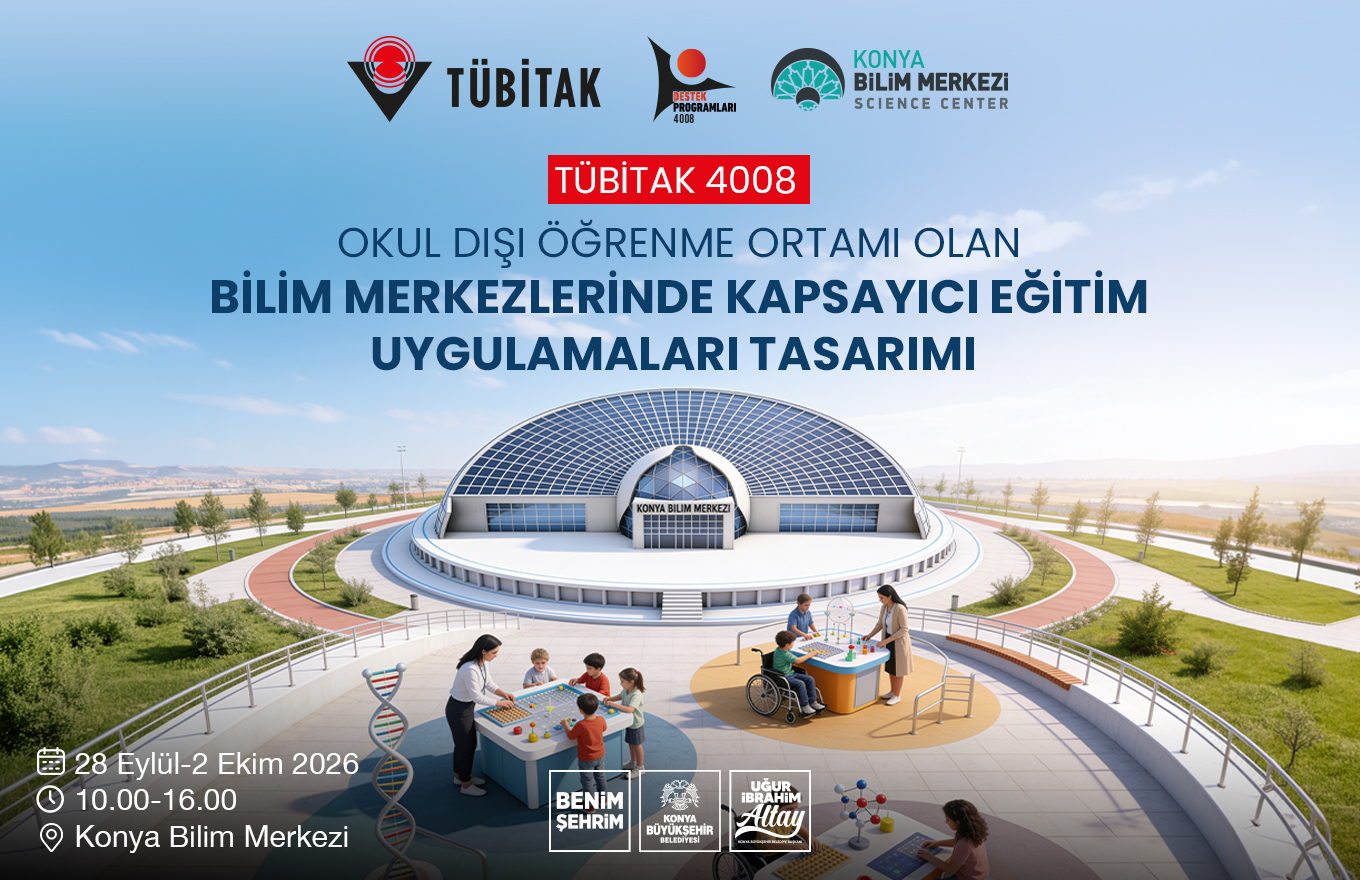
28/09/2026 Time: 10:00 - 16:00
-
29/09/2026 Time: 10:00 - 16:00
-
30/09/2026 Time: 10:00 - 16:00
-
01/10/2026 Time: 10:00 - 16:00
-
02/10/2026 Time: 10:00 - 16:00
The training program will be held at the Konya Science Center campus over a period of five days.
About the Project
“Designing Inclusive Education Practices in Science Centers as Out-of-School Learning Environments” is a comprehensive TÜBİTAK 4008 Inclusive Society Practices for Individuals with Special Needs Project, aimed at ensuring the full, high-quality, and equitable participation of individuals with special needs in educational processes.
The main objective of the project is to enhance the professional self-efficacy of teachers working in public and private educational institutions across Türkiye who have students with special needs in their classrooms, strengthen levels of social acceptance, and enable teachers to integrate the interactive opportunities offered by science centers as out-of-school learning environments into their lesson designs.
Throughout the program, topics such as organizing learning environments, adapting instruction according to individual differences, developing educational materials, classroom management, and family participation will be addressed through hands-on activities.
The program will include interactive content such as case studies, simulations, role-playing activities, virtual reality applications, STEAM activities, argumentation practices, and reflective learning sessions.
The project will be carried out with 50 primary participants and 20 reserve participants selected from across Türkiye. In line with the principle of equal opportunity in education, priority will be given to teachers working in disadvantaged regions.
Participation and Application Details
-
Participation Fee: Participation in the training is completely free of charge.
-
Target Group: Teachers from all subject areas who have students with special needs in their classrooms or who actively take part in inclusive/mainstreaming education practices.
-
Transportation: Local transportation for participating teachers will be provided by vehicles allocated in cooperation with Konya Metropolitan Municipality.
WORKSHOPS
1. What Is There?
Open-Ended and Closed-Ended Experiment
Target Group: Participating Teachers
Participating teachers design stations that allow students with special needs to explore various environmental stimuli according to their sensory needs. Experimental processes are designed to support students’ sensory perception by focusing on basic physical characteristics such as color, texture, smell, and size.
2. Speak with Evidence
Argumentation
Target Group: Participating Teachers
This workshop aims to strengthen the ability of individuals with special needs to express their ideas, provide justification, and make decisions. Through structured questions and everyday-life situations, participants experience the claim–reasoning–conclusion cycle and design scientific discussion environments suitable for students’ cognitive levels.
3. Empathy Through Virtual Experience
Augmented / Virtual / Mixed Reality
Target Group: Participating Teachers
Participants directly experience everyday situations related to visual and hearing impairments through virtual and augmented reality simulations. Based on these experiences, learning environments are reassessed, and the use of technology as a tool for developing empathy in inclusive education is explored.
4. My Family, My Activity
Family Participation and Education
Target Group: Participating Teachers
Practice-based plans are developed to support the active participation of families in inclusive education. Participants design sustainable learning activities that can be implemented at home, strengthen school-family cooperation, and develop strategies for family guidance.
5. Hama Beads
Computational Thinking and Fine Motor Development
Target Group: Participating Teachers
Patterns and models are created with colorful beads using templates based on the fundamentals of coding logic. Participants experience coding practices that support both algorithmic thinking skills and the development of fine motor skills and small muscle groups in students with special needs.
6. Discovery Route at the Science Center
Scientific Field Trip and Field Study
Target Group: Participating Teachers
The interactive exhibition galleries and exhibits of the science center are explored. Participants design thematic discovery routes that facilitate the interaction of students with special needs with scientific concepts and apply the curriculum-supporting potential of out-of-school learning environments.
7. Attention and Memory Game Box
Digital Games and Educational Adaptation
Target Group: Participating Teachers
Participants examine board-game and digital-game structures that improve attention, memory, and sequential logical thinking skills. They develop methods for adapting these games according to the needs of students with special needs who have different diagnoses and developmental levels.
8. Nature Observation and Science Notebook
Nature and Field Study
Target Group: Participating Teachers
Outdoor and nature observations are integrated into inclusive education processes. Using science notebook recording techniques, participants prepare observation charts designed to support environmental awareness, attention to detail, and concentration skills among students with special needs.
9. Learning Through Daily Routines
Naturalistic Teaching Approach
Target Group: Participating Teachers
Daily routines such as eating, dressing, classroom gathering, and cleaning are transformed into learning opportunities. Participants design teaching processes embedded in natural contexts in line with Individualized Education Programs (IEPs).
10. Play-Based Interaction
Naturalistic Developmental Behavioral Intervention
Target Group: Participating Teachers
Methods that support social interaction, gestures, facial expressions, and non-verbal communication through play are explored. Participants develop free-play and semi-structured communication games centered on the interests of children with special needs.
11. Sensory Exploration Stations
Educational Games and Sensory-Based Design
Target Group: Participating Teachers
Sensory stations equipped with tactile, visual, and auditory stimuli are designed. Participants practically examine the effects of different stimuli on students’ concentration, anxiety management, and levels of participation in lessons.
12. Gamified Learning Experience
Gamification
Target Group: Participating Teachers
Points, badges, task levels, and instant feedback mechanisms are adapted for inclusive classroom environments. Participants develop gamification dynamics designed to sustain the motivation and interest of individuals with special needs in learning activities.
13. Strengthening Communication Through Technology
Assistive Technologies
Target Group: Participating Teachers
Alternative and augmentative communication systems (AAC) for individuals with communication difficulties are introduced. Participating teachers practice how technology-supported software and tools can be integrated into classroom learning processes.
14. Case-Based Solution Workshop
Problem-Based Learning
Target Group: Participating Teachers
Real-life scenarios encountered in inclusive classrooms are analyzed. Participants use interdisciplinary problem-solving techniques to develop practical alternative solution strategies for behavioral, physical, and pedagogical barriers.
15. Expression Through Tactile Art
Art and Inclusive Design
Target Group: Participating Teachers
Art activities are carried out using different surface textures, clay, and natural materials. Participants examine the potential of tactile art practices in supporting emotional expression and motor control and design adapted art activities.
16. Science Below Zero Show
Science Demonstration and Presentation
Target Group: Participating Teachers
Phase transitions of matter involving solids, liquids, gases, and plasma are demonstrated using liquid nitrogen. Participants observe how visually engaging science demonstrations can be used as pedagogical tools for concept teaching and adapted for inclusive education.
17. Movement and Participation Workshop
Inclusive Sports and Movement
Target Group: Participating Teachers
Inclusive movement activities designed to improve gross motor skills and peer cooperation are developed. Considering individual physical differences, participants create adapted physical activity models that enable every student to participate.
18. S-TEAM: Robotic Mechanisms
STEAM Applications
Target Group: Participating Teachers
Working in teams, participants combine different materials to design simple robotic arms and model mechanisms. Engineering principles are used to support motor functions and create prototype models that can facilitate the daily lives of individuals with special needs.
19. Predict–Observe–Explain Cycle
POE Cycle
Target Group: Participating Teachers
The fundamental stages of scientific inquiry are examined through structured activities. Participants adapt this cycle into simplified and visualized activity designs appropriate for the cognitive levels of individuals with special needs.
20. Affective Workshops
Creative Drama and Role-Playing
Target Group: Participating Teachers
Participants develop emotion dice and case cards. Creative drama and role-playing activities are carried out to improve communication with students who have difficulty expressing their emotions and to encourage empathy in situations involving anger and anxiety.
21. Support Positive Behavior
Applied Behavior Analysis – ABA
Target Group: Participating Teachers
Classroom behavior management and positive reinforcement models are examined within the framework of behavioral approaches. Participants develop plans to prevent challenging behaviors and reinforce positive behaviors and test their applicability in classroom settings.
22. Teacher Sharing Session and Certification
Workshop and Evaluation
Target Group: Participating Teachers
Inclusive models, examples of good practice, and reflective learning outcomes developed throughout the project are presented in subject-based groups. At the end of the program, participants who successfully complete the process will receive official certificates of participation and achievement.
Application Link:
https://forms.gle/g4skuNukkh4jDLUo9